

NAVIGATION
If you’re anything like me when I first started, you have one big question. How much does a tiny house cost to build?
Now that I’ve built my own tiny house and come out the other side, I wanted to do a full tiny house cost breakdown for others. There is a lot that goes into the total cost of a tiny house, so I’ll cover both the big picture numbers and the details behind them.
Your tiny house costs may look a little different depending on when you’re reading this and where you’re located, but by the end, you should have a realistic idea of what it really takes to build, set up, and maintain a tiny house.
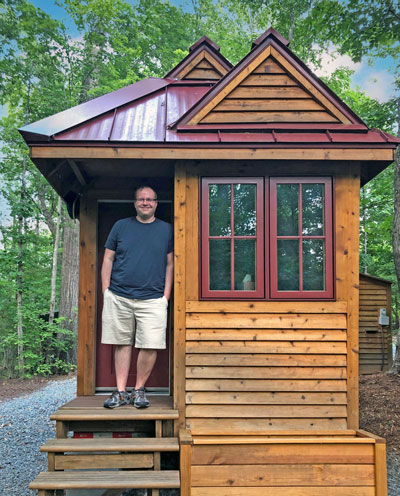
Hi, I’m Ryan
When I first started building my tiny house, I was nervous about how much I was spending. I realized that even though I had solid tiny house plans, I needed to put just as much thought into my budget.

How Much Does A Tiny House Cost?

The average cost of a tiny house usually falls between $30,000 and $60,000 to build yourself, and twice that if you hire a builder to build it for you. But that’s only part of the picture, and depending on the choices you make, your cost to build a tiny house can vary a lot.
Many people hope to build their tiny house at a certain price point because of budget constraints or other factors, so the real question becomes: What’s the difference between a $30,000 tiny house and a $60,000 tiny house?
Tiny House Cost By Square Foot

The average cost of a tiny house on wheels is $150 to $450 per square foot. That means building a 400 square foot tiny house costs an average of $60,000 to $180,000, while a 500 square foot tiny house usually falls around $75,000 to $225,000.
Although the price per square foot isn’t too far off from that of building a traditional home, the smaller footprint means your total cost will be significantly lower.
Price Ranges
- Trailer: $5,000 – $15,000
- Windows: $1,000 – $7,000
- Metal roofing: $1,000 – $3,000
- Insulation: $800 – $4,000
- Siding: $1,500 – $4,000
- Sheathing: $300 – $1,000
- Lumber: $2,500 – $8,000
- Interior finishes: $1,000 – $5,000
- Doors: $1,000 – $3,000
- Electrical: $1,500 – $5,000
- Shower: $600 – $2,000
- Water heater: $600 – $1,500
- HVAC: $800 – $2,500
- Toilet: $200 – $1,000
- Fixtures: $1,500 – $5,000
- Appliances: $800 – $5,000
- Interior wall: $800 – $2,500
- House wrap: $150 – $500
- Subflooring: $500 – $1,200
- Flooring: $500 – $1,500
- Fasteners/Adhesives: $1,500
- Paint: $200 – $400
- Tools: $1,000 – $3,000
- Delivery: $500 – $10,000
These price ranges are meant to give you a general idea of what your cost to build a tiny house will look like, but there are plenty of ways to save money on your build.
Tiny House Building Materials List: In-Depth Cost Analysis

When it comes to getting a true sense of tiny house costs, you need to understand the different materials that will go into your tiny house. When I first started my build, I had never done anything like it before. What I realized was that if I broke the house down into different parts, I could make it much more manageable. So, that’s how we’ll figure out the estimated cost of your tiny home.
The big thing to know is that most of your budget will be dedicated to your land, trailer, doors/windows, roof, and mechanical installations. These are things that I wouldn’t skimp on at all; I’d buy the best I could afford. This will account for 80% of your costs. For example, my trailer cost me $3,600, my doors and windows were $6,000, roof was $2,600, and HVAC was $1,800.
Tiny Home Trailer

The trailer for your tiny house is one of those tiny house costs that you don’t want to skimp on or mess around with. I’ve seen hundreds of beginners try to save money by getting a used trailer. Unless you’re already handy with metalworking and have some experience, you won’t save any money going the used route because repairs, reinforcements, a new paint job and new tires and wheels will leave you broke.
What’s worse, people who go this route end up worrying about whether their trailer is good enough, which is a nightmare when your home is relying on it.
The other mistake I see is people overspending on purpose-built “tiny house trailers”. The differences are minor and all you’re really paying for is the markup. Most tiny house trailer sellers don’t actually make them, so go to the source: Big Tex Trailers, Kaufman Trailers, etc.
Estimated Costs: 20-foot trailer: $5,000, 24-foot trailer: $7,000, 30-foot trailer: $9,000
Windows For A Tiny House

In small spaces, it’s important to choose your windows wisely. A big chunk of my tiny home cost went towards my windows because they were all custom, but if you buy standard window sizes and don’t mind white vinyl windows, you can save a ton. My windows cost me around $6,500 for double-pane, argon-filled, low-E tempered glass.
Windows are one of those things where it’s tempting to save money by going low quality, but you’ll pay for it in your electric bill month after month for the rest of your life. Although it’s more expensive, you definitely want high-quality, energy-efficient tempered glass.
Estimated Costs: $150 per window for stock sizes, $350 per window for custom options
Tiny House Doors

I wanted to try my hand at building my own door, and this was one thing that I struggled with immensely. Even with the help of my grandfather, who is quite a skilled woodworker, we had a tough time building the door. If I had to do it all over again, I’d go with a metal or composite door bought from a manufacturer.
The problem you face with doors is that they have to be exceedingly accurate, and that is compounded by how wood moves, warps, and twists. We employed a lot of techniques to stabilize the wood within the door, but in the end my door is still far from perfect. Do yourself a favor: Have a door manufacturer build your door for you.
Estimated Costs: $500 for self-built door, $800 for basic manufactured door $1,500 good to high-end manufactured door
Roofing Options For A THOW

The roof is a critical part of a tiny house; it keeps your investment safe from water. It’s something you really need to nail. A leaky or improperly installed roof can spell disaster for you and your tiny home.
For a tiny house on wheels that you might want to move, metal roofing is the only practical option. I opted for standing seam metal, which is amazing, but a ribbed metal or corrugated metal roof can work too.
The tricky part of building a metal roof is bending all the custom bits to fit your edges, valleys, drip edges, and skylights. Skylights are notorious for leaks on any roof, so make sure you follow the manufacturer’s directions if you choose to install them.
If you’re thinking of asphalt shingles, don’t bother. They’re too heavy, and they can get torn off while you’re driving down the road.
Estimated Costs: $1,000 for ribbed metal, $2,500 for standing seam
Insulating Your Tiny House

Much like windows, insulation is one of those things where if you spend a little more up front, you’ll save every month for years. The return on your investment is huge, so don’t skimp here.
In the early days I suggested options like standard fiberglass batts, foam board, and even sheep wool. Now that I’ve been working with tiny houses for over a decade, I see how those options have their failings. I now only recommend closed-cell spray foam for insulating a tiny house.
The benefits of spray foam are many, but its ability to seal your thermal envelope, its water resistance, and its ability to prevent condensation issues put it leaps ahead of any other option. It also has the highest R-value per inch of any practical option.
So, this is an easy one. Go with closed-cell spray foam, and if you have a contractor who recommends open-cell, send them packing.
Estimated Costs: $5 per square foot for 3 inches thick (R-21)
Lumber To Build Your House

Tiny house lumber costs can vary a lot depending on the finish quality you’re after, but standard framing lumber costs about the same. There are two real buckets of lumber that you’ll need: framing and finish.
Framing for a tiny house is very affordable; a few hundred dollars up to about $1,000 for the whole house depending on its size and any specialized beams like glulam. There isn’t much price difference here, with the exception of treated vs. untreated lumber.
Finish woods are where you can spend some real money, from a few hundred to a few thousand. At its simplest, you could build out your interior cabinets and built-ins with MDF, which runs about $35 a sheet. My preference is birch plywood, which runs about $50 a sheet. I can stain or paint it, and it makes for a much nicer project.
The only non-sheet goods you’ll use are timber beams for your accents and loft framing. For that, I spent about $80 per beam and had five of them.
Estimated Cost: $2,500 – $8,000
Flooring Options For Your Tiny House

When it comes to tiny home flooring, you can really run the gamut depending on the price you want to pay, but it’s one area where you can find savings. You can find reclaimed flooring, you can buy short lots of flooring, and you can even go with a more affordable option now and upgrade later. I’ve even seen people do a finished floor with plywood.
I personally went with a solid hardwood maple floor that was about $4 per square foot.
Estimated Cost: $2.50 – $12 per square foot
Electrical/Plumbing In A Tiny House

Wiring and plumbing your tiny house can be done affordably if you want to do it yourself. If you need to hire a tradesperson, then it’s going to cost you. It’s important to note that many places require a permit, and some require the work to be done by a licensed electrician or plumber.
In my area, an electrician costs between $75 and $150 an hour, and plumbers are about the same. What I did was have the electrician install the main breaker panel connection and setup, then I did the rest of the work. For the plumber, I installed everything myself and had him come in to do my crimps and check over my work.
With electrical and plumbing, most of the cost and price variability is in the labor. The parts are what they are, and you won’t find better prices shopping around because they’re commodity goods. Figure about $300 – $500 in electrical supplies and $300 – $500 in plumbing supplies. This doesn’t include fixtures like faucets and showers, just the actual connections.
Estimated Cost: $1,500 – $5,000
HVAC For Tiny Homes

Your HVAC is responsible for keeping your tiny home cool in the summer and warm in the winter, so it’s a necessity for year-round comfort. I went with a mini-split heat pump. The wall-mount saves a ton of space, the energy efficiency keeps my power usage low, and it provides both heating and cooling with a single unit.
I installed it myself, so it only cost $1,800 in total. Hiring a professional would have upped my expenses to around $3,500, making it well worth the extra elbow grease.
And as much as I love mini-splits, there are other ways to keep your HVAC costs low. Window AC units start at just $200, and you can find a wood-burning stove for about $600. While they aren’t as convenient as a dedicated heating and cooling system, they’ll get the job done just fine.
Estimated Cost: $800 – $2,500
Tiny Home Fixtures

In this category, I’m lumping together things like lights, bathtubs, shower stalls, sinks, mounted fans, etc. You can do most of this affordably, except for the shower. The lowest you can reasonably go is a simple 32×32-inch shower stall for about $400. You could look for a more inexpensive option, but I’ve found cheaper shower stalls often fail and lead to massive water damage.
A sink can cost anywhere from $50 to $500. I paid about $225 for a nice stainless steel under mounted sink. My light fixtures were also inexpensive – a bunch of $10 puck lights and a $80 ceiling fan.
Estimated Cost: $1,500 – $5,000
Fasteners And Adhesives

This is one category that people always forget to budget for, and it’s something you can’t reuse or find secondhand. You need quality fasteners and glues that are new because you need to know exactly what you’re getting for safety’s sake. Building code also has very specific rules around this.
I spent around $1,500 on all of my nails, screws, metal strapping, glues, and various metal ties.
Estimated Cost: $1,500
Tiny House Costs Beyond The Build

Your tiny house cost will include more than just the construction. You still need to think about where your house will sit, how you’ll get it there, and what the house needs to be move-in ready.
Land And Parking
The land you park your tiny home on will end up being as much of your home as the tiny house itself. It’s a huge decision, and there are a few ways to go about it. You can buy a lot, rent a spot in a tiny house community, or park your tiny home on family land.
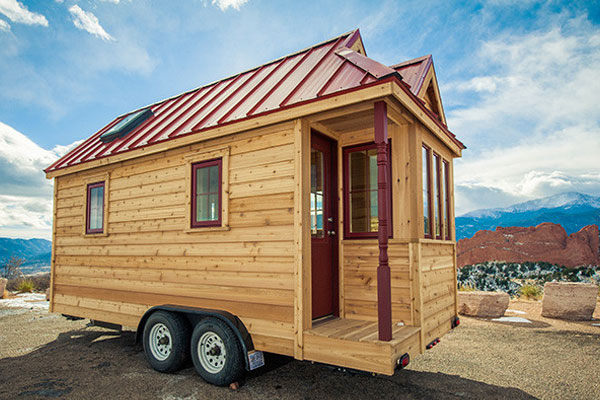 Buying land is typically the most expensive option, but it gives you a level of freedom and flexibility that’s hard to find elsewhere. And land prices can be surprisingly reasonable! Down here in the Carolinas, rural parcels start at just $2,000 per acre. The only downside is that you’re on the hook for any grading, site preparation, and utility hookups you’ll need to make the land livable.
Tiny home communities are another great option, but they can be hard to find. Instead of buying the land outright, you’re basically renting a lot for $500 to $900 a month. Tiny home communities are great because most come with access to water, electricity, sewer, and other shared amenities. However, you’re trading control for convenience. Some communities maintain strict rules regarding what you can or can’t do with your tiny home.
The last and least expensive option is to park your tiny house on family land. Of course, you’ll need a willing family member, but doing so may help you avoid lot and land purchasing fees. If you plan on staying there for a while, I recommend drafting a written agreement so everyone is on the same page about ongoing costs and maintenance. It’ll also come in handy if circumstances change or if the landowner decides to sell.
It’s also worth mentioning that one of the main perks of building a tiny house on wheels is that they’re well suited for life on the road. If you want to travel full time, you can simply alternate between parking your tiny home at campgrounds, RV parks, parking lots, and private land.
Estimated Costs: $900 – $200,000
Tiny House Utility Hookups
Utilities like running water, electricity, and working toilets are one of those things that make a tiny house feel like a tiny home. When installing utilities, there are essentially two paths you can take.
The first is to tap into existing water, sewer, and electric connections. Depending on where you are and what’s available, the average cost of a municipal water connection is roughly $1,000 to $5,000, while connecting to the electrical grid can run you $750 for a simple RV-style hookup to $7,000+ for a professional installation. At $1,500 to $20,000, septic installations may be your biggest utility expense.
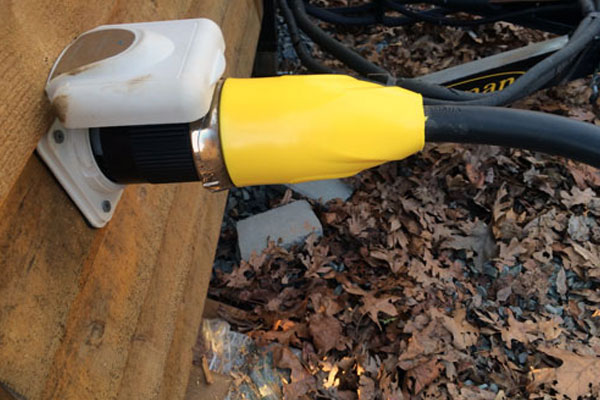 I know municipal hookups aren’t for everyone, so those of you looking for a more independent setup may want to consider building an off-grid utility system instead. Solar panels and batteries can replace the electrical grid; composting toilets can replace traditional sewage; and a combination of water tanks and greywater systems can provide your household with water.
A basic off-grid utility installation can run anywhere from $6,500 to $25,000, depending on how you go about it. Just keep in mind that the initial installation cost doesn’t necessarily mean going off grid is more expensive overall. For example, digging a well cost me an initial investment of $4,000, but I’ve already saved more than three times that amount (and counting!) on water costs.
Estimated Costs: $1,500 – $5,000 for on-grid utility hookups, $7,000 – $20,000 for off-grid hookups
Insurance And Property Tax For Tiny Houses
Insurance is something I see a lot of aspiring tiny homeowners overlook, but trust me: It’s one of those things you’ll want to figure out before you ever start construction. A tiny house on wheels may need an RV policy, while a tiny house on a foundation may qualify for traditional home insurance. I’ve also seen some people skip insurance altogether, provided they own their tiny home outright and keep it parked on private land.
Property taxes will also look a little different depending on whether your tiny home is on wheels vs. a permanent foundation. While tiny homes on foundations are seen as regular real estate, THOWs are treated more like personal property.
Estimated Costs: $500 – $3,000 annually
Ongoing And Hidden Costs Of Tiny Homes
By this point, you probably have a pretty good idea of what your tiny house construction costs will look like. However, the costs don’t end there. Like any other home, tiny houses need regular maintenance and repairs. THOWs may also come with some additional expenses if you need to transport the home or rent storage.
 It’s hard to say how much I spend each year on miscellaneous expenses. In a good year, I may only spend a couple thousand or so on routine maintenance. However, a bad storm, leaky roof, or broken appliance can easily push my yearly expenses into the tens of thousands, so I always recommend keeping an emergency fund available.
I’d also like to mention that tiny homes tend to depreciate, which matters if you ever decide to sell. Don’t get me wrong: You can sell at a good price, but you shouldn’t assume you’ll automatically be able to recoup 100% of your expenses.
Estimated Cost: $3,500+ per year
How Much Do Tiny Houses On Wheels Cost?

A tiny house on wheels costs about the same as a tiny house on a foundation, but instead of paying $3,000 to $20,000 for a permanent foundation, you’ll pay $5,000 to $20,000 for a trailer.
When deciding on a trailer, first estimate the size and weight of your finished (and fully furnished) tiny home, and use that information to narrow down a trailer type.
Large or heavy homes will need a more robust towing system like a fifth wheel or gooseneck, while small, lightweight tiny homes can be pulled by a simple bumper pull. Here’s some more information on gooseneck and fifth wheel tiny homes if you still have questions.
Once you’ve decided on a trailer type, it’s time to start your search. As you go through the many options available, pay close attention to the trailer’s gross vehicle weight rating (GVWR), deck dimensions, axles, and payload capacity. You want to make sure the trailer can safely support your fully furnished tiny home and remains safe and stable enough to handle sharp turns, highway speeds, and sudden braking.
As a general rule of thumb, the larger and more heavy duty a trailer is, the more expensive it will be. So, a basic 20-foot bumper pull trailer may only cost around $6,000, while a 36-foot gooseneck trailer starts at nearly $12,000.

Tiny House Costs: Building Vs. Buying From A Builder

The question I’m asked most often is whether to build or buy a tiny home. Here’s the truth: If you want someone to build you a tiny house, it’s going to cost you big time. Tiny houses took off because they can save you so much money, for two reasons: They’re smaller, and you can build them yourself. There is no way around it: Having a builder will significantly increase your cost.
 About 50%-60% of the cost of a home (tiny or traditional) is in labor, so the rule of thumb I tell people is to take the cost of the materials and then double it. A tiny house that costs $30,000 in materials will cost about $60,000 – $65,000 to get professionally built, and a tiny house that is $60k in materials will cost around $120,000 – $125,000. (If you do use a builder, make sure to get a contract!)
This leads me to the big takeaway: Tiny houses make the most sense if you can build them yourself. The good news is that I truly believe that anyone (yes, even you) can build a tiny house. Even if you’ve never used a tool in your life, never built anything, aren’t that strong, or don’t know how, you can build a tiny house. I put all the info you’ll need to do it yourself in my book: How To Build A Tiny House.
By building your own tiny home, you’ll save a ton on construction costs, learn valuable skills, and know your house was built right because you built it – not a builder trying to turn out a house every month for profit.
When To Bring In A Tiny Home Builder
Although I believe that everyone is capable of building their own tiny home, I understand that not everyone wants to. And look, I get it! In addition to the financial commitment, building your own tiny home takes time – especially if you’re working alone.
What might take you well over six months to complete can be knocked out by professionals in just 10 weeks. So if you’re working full time or have a tight deadline, bringing in a builder makes sense. Fortunately, hiring a builder doesn’t have to be all or nothing!
Using a hybrid approach lets you save money by handling the stuff you’re comfortable with, while leaving the time-consuming or complex jobs to the people who have the training and experience to deal with them. Here are some of the areas where it often makes sense to bring in a pro:
- Electrical work
- HVAC
- Welding or trailer modifications
- Roofing
- Plumbing
- Septic installations
Tiny Houses Cost Money, But It’s Worth It
When I made the leap to living in a tiny house, I was worried about how much it was costing me. But I knew if I lived in my tiny house for two years, I’d break even compared to paying rent for an apartment.
Now I’ve been living in my tiny house full time for over a decade, and I couldn’t be happier. I have more money in the bank than ever while working fewer hours. It’s a winning combination.
Since going tiny, I’ve left my corporate job to work for myself, and I spend more time with friends and family and traveling. It’s an amazing lifestyle and it all starts with taking charge of your life and going tiny.
Your Turn!
- How much does it cost to build a tiny house where you’re located?
- Which tiny house construction cost surprised you the most?
I really can understand and appreciate the effort that you took to design and build this website!! I’m a social worker, and am considering building my own Tiny home. I have just recently realized that the system is rigged, and everything is inflated cost wise, I’ve been browsing ALOT of companies that sell tiny homes, and the mark up is insane.. Would love to learn more, and I have learned a lot here.. Thank you for your time and dedication to education.
It has definitely made the concept easier for me to digest, something that I am pondering is the by law, and regulations of tiny homes when they are being transported in Canada. Wondering if you could elaborate more on the dimensions, examples, or even links of materials that you are aware of. I am wanting a two bedroom Tiny home, and designing a loft that is functional and takes up the least amount of space is important for me.
Thank You for sharing, I’m on a fixed income & interested in building my own tiny house , I’m researching cargo containers , I’m looking into building as cheap as possible for 1 person around 350 square ft. If anyone has any advice for me it will be greatly appreciated . websites etc.
Hello Michael, I am looking for something close to what you are interested in. I am new to this as well. Can we partner? I live in Florida but looking for a community anywhere in the US.
I couldn’t find where it said the size of your tiny home and what year you built it for price references. Thanks so much for your great guide!
I have $7000 how big of a tiny house can I build since I’ll be doing it myself and I have enough property to do it on??
Maybe can only afford between 2,000 or 3,000 me and my little family want to live better and stop living paycheck to paycheck we are in need of a 2 bedroom!
This is a great list and so cool to see, but what about those of us who are planning to build something that will be permanent? Something we plan to place on a concrete slab and connect plumbing and power to them from our house or garage?
I have a 80 x 130 foot lot and I want to add some ADUs to it for fun and rentals. But they will never leave the property, where are the pages for the non-trailer tiny homes?
Thanks,
Jack
Great article on cost savings on
a tiny house
Looking to build a Veterans Tiny House community. Will give you a call next week or the week after. Thanks
I’ve read your article again and again. Thanks for writing it. It helps me to stay focused while the build is going on. I’m happy that I decided on a tiny house and I’m sticking to it. Your article helps me to question the pricing that my builder offers to me. In the long run I love the process because I can afford to splurge on things that I normally would not do in a big house, like a luxurious shower. I would ask if there are luxurious looking sites on this side of our country, TN, SC, NC, GA, like the ones seen on CA, WA, OR sites? What I’ve seen on the websites is replicas of mobile home parks that mostly want to sell or rent tiny houses. Nothing for the serious owner that wants a lively place to put my home. Also I’ve noticed that these places online that look like old mobile home or camping parks are listed by one group out of Ohio. Help.
Thanks again
Judy N
Ryan,
Thank you so much for putting ‘pen to paper’ and sharing your experience in building TINY! Not only did you publish an extensive narrative on what went right and worked well, you shared a few things you would have changed, in hindsight. I also appreciate your detailed list of supplies and associated costs.
I am in the process of finding a small home as an In-Law house that will be placed near my daughter & son-in-law’s home (in N. Carolina). Fortunately, they have a few acres!
To me, this is information is invaluable, and well worth saving.
Thank You For the information
This is the most honest cost breakdown I have read on tiny houses, and the line doing the most work is “double those numbers if you hire a builder.” That double is labor, and it is the only item on the whole list without its own row. We run a job board for traveling trades workers, so what stands out to us is that the $750 to $3,000 you have down for electrical is materials – the licensed electrician who ties it in is a separate number, and it swings hard depending on which state you are parked in. Anybody pricing a build gets closer to the real total by checking what electricians and carpenters are paid state by state and adding up the days. It will not change the trailer price, but it does explain why two builds off the same materials list come in $20,000 apart.
Great post! I found the breakdown of costs really helpful. It’s interesting to see how much you can save by downsizing. I’m considering a tiny house myself, so this information will definitely help me budget better. Thanks for sharing!
The 50 to 60 percent labor number surprises people every time, and hiring the electrician just for the panel is a smart way to spend that money. We run a job board for traveling trades workers, and one thing worth knowing is that the $75 to $150 an hour you get quoted is the shop’s bill rate, not what the electrician takes home. Journeyman electricians on the jobs we see posted are mostly in the $35 to $45 an hour range, and the rest covers insurance, the truck, licensing and overhead. If you’re curious how that breaks down by state, here’s what electricians and plumbers are actually being paid, read off live job postings.